'%3e%3cpath%20d='M27.0633%2022.1165C27.1976%2022.5199%2026.9522%2023.2015%2026.5156%2023.6381L23.7462%2026.4075C23.0912%2027.0629%2021.861%2027.3153%2021.0009%2026.971L19.7212%2026.4596C12.5536%2023.5922%204.4065%2015.4455%201.53956%208.2775L1.02769%206.99825C0.683813%206.13813%200.936251%204.90788%201.59119%204.25294L4.36056%201.48356C4.79719%201.0465%205.47925%200.801064%205.88219%200.935814C8.09944%201.67475%2010.4996%204.07444%2011.2385%206.29169C11.3728%206.69463%2011.1274%207.37669%2010.6908%207.81331L9.10831%209.39575C8.67125%209.83238%208.54131%2010.6356%208.81737%2011.1878L9.22994%2012.0133C10.4729%2014.4992%2013.4999%2017.5263%2015.9858%2018.7692L16.8109%2019.1818C17.3635%2019.4578%2018.1663%2019.3274%2018.6029%2018.8908L20.1858%2017.3084C20.6224%2016.8718%2021.3041%2016.6263%2021.7074%2016.7606C23.9242%2017.4996%2026.3244%2019.8997%2027.0633%2022.1165Z'%20fill='black'/%3e%3cpath%20d='M12.9259%205.08113L13.0283%206.20331C13.0563%206.51088%2013.2668%206.72788%2013.4986%206.68719C13.4986%206.68719%2013.9278%206.65525%2014.3601%206.66706C16.1919%206.71038%2017.9366%207.46638%2019.2303%208.76794C20.5319%2010.0616%2021.2874%2011.8064%2021.3347%2013.6417C21.3509%2014.2358%2021.2848%2014.8234%2021.2787%2014.8466C21.2034%2015.1463%2021.3863%2015.4455%2021.6873%2015.5151L22.7754%2015.7662C23.0764%2015.8358%2023.3809%2015.6485%2023.4544%2015.3488C23.5056%2015.1428%2023.5913%2014.3662%2023.5703%2013.5826C23.5108%2011.1733%2022.5177%208.88256%2020.8128%207.1855C19.1153%205.48013%2016.8249%204.487%2014.4156%204.42794C13.8968%204.41394%2013.3818%204.44675%2013.3818%204.44675C13.1023%204.48919%2012.8984%204.77356%2012.9259%205.08113Z'%20fill='black'/%3e%3cpath%20fill-rule='evenodd'%20clip-rule='evenodd'%20d='M12.6026%201.52338L12.7041%202.63725C12.7321%202.94481%2012.9811%203.16531%2013.2602%203.129C13.2602%203.129%2013.7707%203.10188%2014.2809%203.11413C17.0699%203.18938%2019.7168%204.333%2021.679%206.31094L21.6869%206.31881C21.6829%206.31488%2021.6829%206.31488%2021.679%206.31094C21.6829%206.31488%2021.6829%206.31488%2021.6829%206.31488L21.6869%206.31881C23.6652%208.281%2024.8124%2010.9318%2024.8837%2013.7169C24.9038%2014.5499%2024.8189%2015.3834%2024.7581%2015.6494C24.6894%2015.9508%2024.878%2016.2514%2025.179%2016.3209L26.2706%2016.5729C26.5716%2016.6421%2026.8713%2016.4539%2026.9399%2016.1529C27.0423%2015.7049%2027.1456%2014.6838%2027.1228%2013.6618C27.0357%2010.2988%2025.655%207.09844%2023.2654%204.73244C23.2654%204.73244%2023.2654%204.73244%2023.2614%204.7285L23.2654%204.73244C20.8998%202.34281%2017.6991%200.962063%2014.3404%200.878938C13.741%200.8645%2013.1434%200.893813%2013.1075%200.898188C12.8008%200.935813%2012.5746%201.21581%2012.6026%201.52338ZM23.2614%204.7285C23.2654%204.73244%2023.2654%204.73244%2023.2654%204.73244L23.2614%204.7285Z'%20fill='black'/%3e%3c/g%3e%3cdefs%3e%3cclipPath%20id='clip0_1330_2768'%3e%3crect%20width='28'%20height='28'%20fill='white'/%3e%3c/clipPath%3e%3c/defs%3e%3c/svg%3e)


What Is a Virtual CFO and Does My Business Need One?
A Virtual CFO provides strategic financial leadership without the cost of a full-time CFO. Learn what a Virtual CFO does, the benefits for growing businesses, and how to determine whether your company is ready for CFO-level financial guidance in 2026.
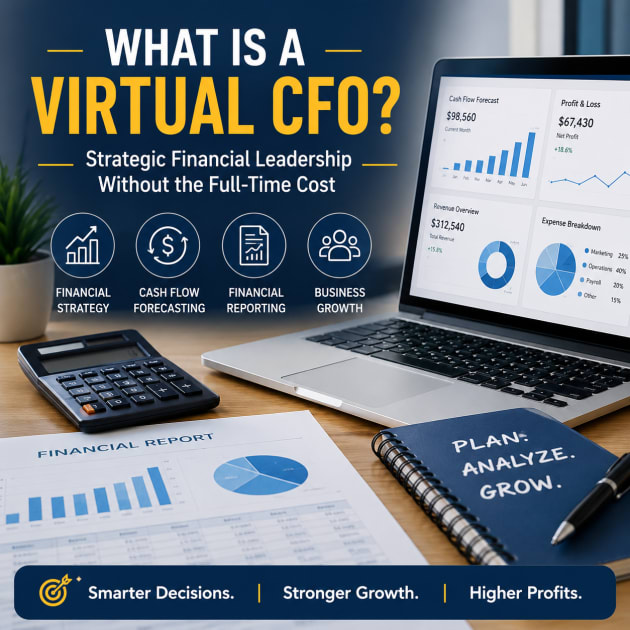
What Is a Virtual CFO — and Does Your Business Need One?
Introduction
Every growing business reaches a point where financial decisions become too complex to manage alone.
Cash flow pressures build up.
Tax planning gets complicated.
Investors start asking questions you are not prepared to answer.
And the spreadsheet you have been running since day one simply stops being enough.
At that point, most business owners think they need to hire a full-time CFO.
But in 2026, there is a smarter option.
A Virtual CFO.
This guide explains exactly what a Virtual CFO does, who needs one, and whether your business is ready for one.
What Is a Virtual CFO?
A Virtual CFO also called a fractional CFO or part-time CFO, is an experienced financial professional who provides CFO-level services to your business without being a full-time employee.
They work with your business on a flexible, ongoing basis.
They bring the same strategic financial expertise as a traditional CFO.
But at a fraction of the cost.
In 2026, Virtual CFO services are delivered remotely using cloud accounting platforms, real-time dashboards, and regular video calls, making them just as effective as an in-house hire, regardless of where your business is located.
What Does a Virtual CFO Actually Do?
This is where most business owners get surprised.
A Virtual CFO is not a bookkeeper.
They are not an accountant who files your returns.
A Virtual CFO operates at a strategic level; they help you understand your numbers and use them to make better business decisions.
Their core responsibilities typically include:
- Cash Flow Management:- Forecasting your cash position weeks and months ahead, identifying gaps before they become crises, and building strategies to keep the business funded.
- Financial Reporting and Analysis:- Turning raw numbers into clear, decision-ready reports. Profit and loss analysis, margin reviews, variance reporting, and KPI dashboards.
- Budgeting and Forecasting:- Building annual budgets, quarterly forecasts, and scenario models that help leadership plan for growth, downturns, and opportunities.
- Fundraising and Investor Readiness:- Preparing financial models, pitch decks, and due diligence documentation for investors, banks, or lenders.
- Tax Planning and Compliance Strategy:- Working with your tax advisors to plan ahead and reduce your tax exposure, not just file returns after the fact.
- Cost Control and Profitability Analysis:- Identifying where money is leaking, which products or clients are most profitable, and where operational efficiency can be improved.
- Banking and Lender Relationships:- Managing relationships with banks and lenders, structuring debt, and ensuring your business maintains healthy credit facilities.
- Financial Systems and Technology:- Implementing and optimizing cloud accounting systems, reporting tools, and financial workflows.
Virtual CFO vs. In-House CFO: What Is the Difference?
The difference is not capability.
It is cost, flexibility, and fit.
An experienced in-house CFO in the US commands a salary of $150,000 to $300,000 per year plus benefits, bonuses, and equity in some cases.
For most small and mid-sized businesses, that cost is not justified by the workload or stage of growth.
A Virtual CFO delivers the same strategic value on a retainer model, typically $2,000 to $10,000 per month depending on scope, and scales with your business needs.
When you need more, you get more.
When the workload reduces, costs adjust accordingly.
There is no recruitment, no notice period, no redundancy.
Just expert financial leadership, when you need it.
Signs Your Business Needs a Virtual CFO
Not every business needs a Virtual CFO today.
But certain signs suggest you are ready or overdue.
You are growing fast but cannot see where the money is going.
Revenue is up. But cash is tight. Margins are unclear. And no one in the business has a clear picture of what is actually driving the numbers.
You are preparing to raise funding.
Investors do not just want a good idea. They want clean books, credible projections, and someone who can speak confidently about the financials. A Virtual CFO prepares all of this and often presents alongside the founder.
Your accountant is reactive, not proactive.
If your current accountant only appears at year-end to file returns, you are missing strategic financial guidance throughout the year. A Virtual CFO fills that gap.
You are making major decisions without financial models.
Hiring decisions, pricing changes, new market entry, and major capital investments need financial analysis, not gut feel. A Virtual CFO builds the models that support confident decision-making.
Your cash flow is unpredictable.
If you regularly feel surprised by your cash position, either running low unexpectedly or unsure how much you can safely invest, a Virtual CFO brings the forecasting discipline to fix this.
You are preparing for an exit or acquisition.
Selling a business or being acquired requires clean, auditable financials, a credible financial narrative, and someone who can represent the numbers in due diligence. A Virtual CFO is critical at this stage.
What a Virtual CFO Is Not
It is worth being clear about what a Virtual CFO does not replace.
A Virtual CFO is not a replacement for your bookkeeper or accountant.
They rely on clean, accurate books to do their work. If your bookkeeping is behind or unreliable, that needs to be fixed first.
A Virtual CFO is a strategic layer on top of your existing accounting function, not a substitute for it.
Who Benefits Most From a Virtual CFO?
Virtual CFO services are most valuable for:-
- Startups scaling rapidly who need financial discipline and investor-ready reporting
- SMBs between $1M and $20M in revenue who have outgrown basic bookkeeping but cannot justify a full-time CFO hire
- Businesses seeking funding debt, equity, or government grants
- E-commerce and SaaS businesses with complex revenue recognition or high transaction volumes
- Businesses planning an exit within the next 2 to 5 years
- CPA firm clients who need strategic financial guidance beyond compliance
The NimbleFincorp Virtual CFO Model
At NimbleFincorp, we provide Virtual CFO services to growing businesses across the US and UK.
Our Virtual CFO engagements are built around your business, not a generic template.
We work within your existing accounting systems, integrate with your team, and deliver clear, actionable financial intelligence on a regular basis.
Our clients get:
- Monthly management accounts with commentary
- Rolling cash flow forecasts
- Budget vs actual analysis
- KPI dashboards tailored to their business
- Strategic financial advice on demand
- Support through fundraising, banking, and growth decisions
You get a senior financial partner without the cost of a full-time hire.
How to Know If You Are Ready
Ask yourself three questions.
Are my financial reports telling me what I need to know to run this business well?
Am I confident in my cash position three months from now?
Do I have someone in my corner who understands the numbers and helps me make better decisions?
If the answer to any of those is no, you are ready for a Virtual CFO.
Final Thoughts
A Virtual CFO is not a luxury reserved for large companies.
In 2026, it is one of the smartest investments a growing business can make.
The businesses that scale efficiently, raise capital successfully, and exit on their own terms are almost always the ones with strong financial leadership guiding them.
You do not need a full-time hire to get that.
You need the right partner.

Written by
Matri Vyas
Founder & CEO
Matri is the founder and CEO of NimbleFinCorp. A QuickBooks Advanced ProAdvisor and Xero-certified advisor with a financial-modeling background, she helps CPA and ACCA firms cut back-office costs by rebuilding the workflow underneath the numbers — not by cutting corners.

Focus on Growth — Leave the Numbers to Us
Streamline your finances with Nimblefincorp's expert virtual bookkeeping and accounting services. From startups to global businesses, we manage your books so you can manage your success.
Focus on Growth —
Leave the Numbers to Us
Streamline your finances with Nimblefincorp's expert virtual bookkeeping and accounting services. From startups to global businesses, we manage your books so you can manage your success.