'%3e%3cpath%20d='M27.0633%2022.1165C27.1976%2022.5199%2026.9522%2023.2015%2026.5156%2023.6381L23.7462%2026.4075C23.0912%2027.0629%2021.861%2027.3153%2021.0009%2026.971L19.7212%2026.4596C12.5536%2023.5922%204.4065%2015.4455%201.53956%208.2775L1.02769%206.99825C0.683813%206.13813%200.936251%204.90788%201.59119%204.25294L4.36056%201.48356C4.79719%201.0465%205.47925%200.801064%205.88219%200.935814C8.09944%201.67475%2010.4996%204.07444%2011.2385%206.29169C11.3728%206.69463%2011.1274%207.37669%2010.6908%207.81331L9.10831%209.39575C8.67125%209.83238%208.54131%2010.6356%208.81737%2011.1878L9.22994%2012.0133C10.4729%2014.4992%2013.4999%2017.5263%2015.9858%2018.7692L16.8109%2019.1818C17.3635%2019.4578%2018.1663%2019.3274%2018.6029%2018.8908L20.1858%2017.3084C20.6224%2016.8718%2021.3041%2016.6263%2021.7074%2016.7606C23.9242%2017.4996%2026.3244%2019.8997%2027.0633%2022.1165Z'%20fill='black'/%3e%3cpath%20d='M12.9259%205.08113L13.0283%206.20331C13.0563%206.51088%2013.2668%206.72788%2013.4986%206.68719C13.4986%206.68719%2013.9278%206.65525%2014.3601%206.66706C16.1919%206.71038%2017.9366%207.46638%2019.2303%208.76794C20.5319%2010.0616%2021.2874%2011.8064%2021.3347%2013.6417C21.3509%2014.2358%2021.2848%2014.8234%2021.2787%2014.8466C21.2034%2015.1463%2021.3863%2015.4455%2021.6873%2015.5151L22.7754%2015.7662C23.0764%2015.8358%2023.3809%2015.6485%2023.4544%2015.3488C23.5056%2015.1428%2023.5913%2014.3662%2023.5703%2013.5826C23.5108%2011.1733%2022.5177%208.88256%2020.8128%207.1855C19.1153%205.48013%2016.8249%204.487%2014.4156%204.42794C13.8968%204.41394%2013.3818%204.44675%2013.3818%204.44675C13.1023%204.48919%2012.8984%204.77356%2012.9259%205.08113Z'%20fill='black'/%3e%3cpath%20fill-rule='evenodd'%20clip-rule='evenodd'%20d='M12.6026%201.52338L12.7041%202.63725C12.7321%202.94481%2012.9811%203.16531%2013.2602%203.129C13.2602%203.129%2013.7707%203.10188%2014.2809%203.11413C17.0699%203.18938%2019.7168%204.333%2021.679%206.31094L21.6869%206.31881C21.6829%206.31488%2021.6829%206.31488%2021.679%206.31094C21.6829%206.31488%2021.6829%206.31488%2021.6829%206.31488L21.6869%206.31881C23.6652%208.281%2024.8124%2010.9318%2024.8837%2013.7169C24.9038%2014.5499%2024.8189%2015.3834%2024.7581%2015.6494C24.6894%2015.9508%2024.878%2016.2514%2025.179%2016.3209L26.2706%2016.5729C26.5716%2016.6421%2026.8713%2016.4539%2026.9399%2016.1529C27.0423%2015.7049%2027.1456%2014.6838%2027.1228%2013.6618C27.0357%2010.2988%2025.655%207.09844%2023.2654%204.73244C23.2654%204.73244%2023.2654%204.73244%2023.2614%204.7285L23.2654%204.73244C20.8998%202.34281%2017.6991%200.962063%2014.3404%200.878938C13.741%200.8645%2013.1434%200.893813%2013.1075%200.898188C12.8008%200.935813%2012.5746%201.21581%2012.6026%201.52338ZM23.2614%204.7285C23.2654%204.73244%2023.2654%204.73244%2023.2654%204.73244L23.2614%204.7285Z'%20fill='black'/%3e%3c/g%3e%3cdefs%3e%3cclipPath%20id='clip0_1330_2768'%3e%3crect%20width='28'%20height='28'%20fill='white'/%3e%3c/clipPath%3e%3c/defs%3e%3c/svg%3e)


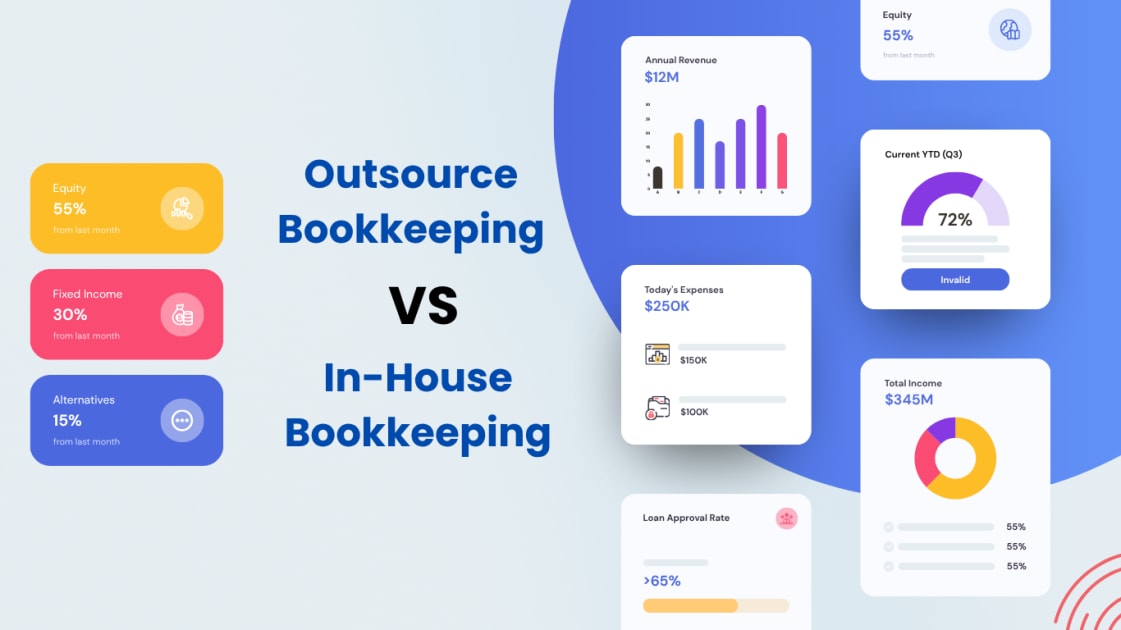
Outsourced Bookkeeping vs In-House Bookkeeping: Which Is Better for Small Businesses in 2026?
Discover the key differences between outsourced bookkeeping and in-house bookkeeping in 2026. Learn which option offers better scalability, cost efficiency, automation, and financial visibility for growing small businesses.
Introduction
Every growing business eventually reaches a point where bookkeeping becomes too large, too time-consuming, and too critical to manage casually.
Invoices pile up. Reconciliations get delayed. Financial reports stop reflecting the true condition of the business.
At that point, business owners face an important decision:
Should bookkeeping stay in-house or should it be outsourced to a dedicated accounting team?
In 2026, this decision matters more than ever.
Rising labor costs, bookkeeping talent shortages, cloud accounting systems, and AI-powered automation are reshaping how businesses manage their financial operations.
And increasingly, small businesses across the US and UK are realizing something important:
Maintaining a full in-house bookkeeping setup is not always the most efficient or scalable solution.
The Traditional Thinking Around In-House Bookkeeping
For years, business owners believed that keeping bookkeeping internally provided more control.
An in-house bookkeeper could:
- Sit inside the office
- Communicate directly with management
- Handle day-to-day accounting tasks
- Maintain financial records internally
For many businesses, this felt safer and more familiar.
But in practice, the in-house bookkeeping model comes with significant operational challenges.
Especially in 2026.
Businesses are now dealing with:
- Rising payroll costs
- Recruitment difficulties
- Employee turnover
- Increased software expenses
- Growing transaction volumes
As financial operations become more complex, relying on one internal employee often creates bottlenecks instead of efficiency.
Why Outsourced Bookkeeping Is Growing Rapidly
Outsourced bookkeeping has evolved dramatically over the last few years.
It is no longer viewed as basic back-office support.
Modern outsourced bookkeeping providers now offer the following:
- Real-time cloud bookkeeping
- AI-powered transaction categorization
- Automated reconciliations
- Financial reporting
- Payroll support
- Accounts payable and receivable management
- Month-end close preparation
Using platforms like QuickBooks Online, Xero, and Zoho Books, outsourced accounting teams can now operate almost identically to internal bookkeeping departments.
The difference?
Businesses gain scalability and lower operational overhead without sacrificing financial visibility.
The Real Cost Difference
One of the biggest misconceptions about in-house bookkeeping is that salary is the only expense.
In reality, hiring internally includes:
- Payroll taxes
- Employee benefits
- Paid leave
- Recruitment costs
- Office setup
- Software licenses
- Training and onboarding
- Productivity loss during ramp-up
In many cases, the total cost of maintaining an internal bookkeeping employee becomes significantly higher than expected.
Outsourced bookkeeping works differently.
Most providers operate on:
- Fixed monthly retainers
- Flexible service packages
- Scalable support models
Businesses avoid:
- Hiring costs
- Employee turnover risk
- Training responsibilities
- Additional infrastructure expenses
For many small businesses, outsourced bookkeeping reduces accounting overhead while improving operational efficiency.
The Scalability Problem Most Businesses Ignore
This is where the difference becomes very clear.
Business growth is rarely predictable.
Transaction volume increases.
Tax season creates pressure.
New clients create additional workload.
Expansion creates more reporting complexity.
The in-house model struggles with sudden growth because capacity depends entirely on internal staffing.
If the workload doubles, businesses often need to
- Hire additional staff
- Expand internal systems
- Increase payroll spending
- Spend time training new employees
Outsourced bookkeeping is built differently.
Scalable accounting teams can quickly adjust based on workload requirements.
This gives businesses:
- Flexible support
- Faster onboarding
- Additional capacity during busy periods
- Reduced operational pressure
For startups and fast-growing businesses, this flexibility becomes a major advantage.
Technology Is Changing the Equation
Bookkeeping in 2026 is no longer manual.
Modern accounting systems now rely heavily on:
- Cloud accounting
- AI automation
- OCR invoice scanning
- Automated reconciliations
- Real-time dashboards
- Smart reporting systems
Professional outsourced bookkeeping firms invest heavily in these technologies because they operate at scale.
Most small businesses cannot justify building this level of infrastructure internally.
This creates a major advantage for outsourcing.
Businesses gain access to:
- Better automation
- Faster reporting
- Improved accuracy
- Modern accounting systems
Without needing to manage the technology themselves.
Accuracy and Quality Control
This is one of the most important comparisons.
A single in-house bookkeeper may understand the business deeply over time.
But quality depends heavily on one individual’s:
- Skill level
- Experience
- Consistency
- Availability
If that employee leaves, operations are disrupted immediately.
Outsourced bookkeeping providers typically operate through structured review systems.
Instead of one individual handling everything, work is often:
- Reviewed by multiple professionals
- Standardized across processes
- Monitored through workflows
- Supported by automation tools
This reduces:
- Human error
- Missed reconciliations
- Reporting inconsistencies
- Compliance issues
For many small businesses, outsourced bookkeeping actually delivers more consistent accuracy than relying on a single employee internally.
The Biggest Fear: Losing Control
One concern appears in almost every outsourcing discussion:
“If bookkeeping is outsourced, do we lose control?”
In reality, modern cloud accounting has changed how financial visibility works.
With outsourced bookkeeping:
- Business owners still access their books anytime
- Reports are shared in real time
- Approvals remain internal
- Communication is structured and documented
The bookkeeping team prepares and manages the work.
The business still controls decision-making and oversight.
In many cases, outsourced bookkeeping improves visibility because processes become more organized and transparent.
What High-Growth Businesses Are Doing Differently
The businesses scaling most efficiently in 2026 are not building large internal bookkeeping departments.
Instead, they are combining:
- Cloud accounting software
- AI-powered automation
- Outsourced bookkeeping teams
This allows internal leadership to focus on the following:
- Growth strategy
- Operations
- Client relationships
- Cash flow planning
- Financial decision-making
Instead of spending valuable time managing bookkeeping workloads internally.
When In-House Bookkeeping Still Makes Sense
Outsourcing is not the perfect solution for every business.
In-house bookkeeping may still work better when:
- Businesses require constant on-site financial supervision
- Physical cash handling is involved daily
- Financial operations are highly specialized
- The company already has a strong internal finance department
Some businesses genuinely benefit from maintaining direct internal accounting support.
When Outsourced Bookkeeping Clearly Wins
For many small businesses in 2026, outsourced bookkeeping delivers stronger long-term advantages when:
- Cost control matters
- The business is growing rapidly
- Internal hiring has become difficult
- Financial workload changes seasonally
- Scalability is important
- Owners want to reduce operational stress
Outsourcing becomes especially valuable when business owners want professional financial management without building large internal accounting teams.
NimbleFincorp: Scalable Bookkeeping Support for Growing Businesses
At NimbleFincorp, we help businesses across the US and UK build scalable bookkeeping operations through dedicated outsourced accounting support.
Our teams handle:
- Daily bookkeeping
- Bank reconciliations
- Accounts payable and receivable
- Payroll support
- Financial reporting
- Month-end close preparation
- Cleanup and catch-up bookkeeping
We work directly within your existing accounting systems while providing structured, accurate, and review-ready financial records.
This allows business owners to:
- Reduce administrative burden
- Improve reporting accuracy
- Scale operations efficiently
- Focus on business growth instead of bookkeeping stress
Final Thoughts
The decision between outsourced bookkeeping and in-house bookkeeping is no longer just about preference.
In 2026, it became a strategic business decision.
Businesses today need the following:
- Scalability
- Financial visibility
- Cost efficiency
- Automation
- Operational flexibility
For many growing companies, outsourced bookkeeping now delivers these advantages more effectively than traditional in-house models.
That does not mean in-house bookkeeping disappears completely.
But it does mean businesses are becoming far more selective about where internal hiring truly adds value.
The future of bookkeeping is increasingly
- Cloud-based
- Automated
- Scalable
- Outsourced
And the businesses adapting to this shift are positioning themselves for stronger long-term growth.
Written by
Nikita Makwana
Reviewer / Senior Accountant
Nikita is a reviewer and senior accountant at NimbleFinCorp, overseeing bookkeeping, reconciliations and financial statements before they reach the client. A QuickBooks ProAdvisor and Xero-certified advisor, she's at her best turning disorganised financials into clean, audit-ready records.

Focus on Growth — Leave the Numbers to Us
Streamline your finances with Nimblefincorp's expert virtual bookkeeping and accounting services. From startups to global businesses, we manage your books so you can manage your success.
Focus on Growth —
Leave the Numbers to Us
Streamline your finances with Nimblefincorp's expert virtual bookkeeping and accounting services. From startups to global businesses, we manage your books so you can manage your success.